



A plain-language guide for international buyers and renters from Move Miami. This is general information, not legal, tax, immigration or financing advice. Please read the note at the end.
What Every International Buyer and Renter Needs to Know About Miami in 2026

Buying a home in Miami from abroad is common, and renting one before you arrive is even more so. Buyers and renters from Latin America, Canada and Europe tend to ask us the same questions: can I buy, how do I pay, what will the taxes look like, and do I need to fly in to sign.
This guide covers the main paths:
- Buying with cash: the simplest route for many foreign buyers
- Buying with a loan: foreign national programs from some lenders
- Buying through a company: an LLC, with an attorney and CPA
- Renting first: a lease while you learn the city
- Relocating for good: moving your life here from another country
Whichever path you take, these are the things to weigh:
- Florida’s foreign ownership law: whether it applies to you
- Financing: cash, a foreign national loan, and what a lender will ask for
- Taxes: property taxes now, and US tax rules when you sell later
- The building: condo approval, rental rules and insurance
- Distance: touring, signing and wiring money from another country
By the end, you will know which questions to ask, who to ask, and what to have ready before you make an offer or sign a lease.
Move Miami is led by broker Victor A. Ruiz, Esq., a licensed real estate broker who is also an attorney. Our team helps buyers and renters find homes across Miami-Dade, including clients who start their search from another country. In this guide, we share what we walk every international client through on the first call.
Can Foreigners Buy a Home in Miami? The Rules in 2026
In most cases, yes. There is no general federal ban on foreign nationals buying homes in the US, and Florida generally allows it too. Foreign buyers are a big part of the market. The National Association of Realtors reports that foreign buyers purchased 67,100 existing US homes worth $45.3 billion from April 2025 to March 2026, and Florida was the top destination, with 20% of those purchases. Canada and Mexico were the two largest sources of buyers.
Florida’s Foreign Ownership Law (SB 264)
Since 2023, Florida law has limited property purchases by certain buyers connected to “foreign countries of concern.” The statute (Fla. Stat. 692.201 to 692.205) is detailed, but the main points are:
- The countries: the statute names China, Russia, Iran, North Korea, Cuba, the Maduro regime of Venezuela and Syria.
- Who it covers: those governments and their officials, entities based there, and individuals domiciled there who are not US citizens or lawful permanent residents.
- What it limits: agricultural land, and property on or within 10 miles of a military installation or critical infrastructure facility, with a narrow residential exception.
- China: the rules for people and entities from the People’s Republic of China are stricter.
It is your domicile, not your passport alone, that matters, and the details can be technical. At the time of purchase, buyers in Florida sign an affidavit stating that they are not a foreign principal under the law, or that they qualify for an exception. The law has been amended since 2023, including in 2026, so ask an attorney how it applies to you before you make an offer.
A Home Is Not a Visa
Owning a home in Miami does not give you a visa, a green card, or the right to live or work in the US. A visitor visa, for example, does not allow you to work in the US. The EB-5 investor program is a separate path built around investing in a business that creates jobs, not buying a home to live in. As of this writing, the USCIS Policy Manual lists minimums of $1,050,000, or $800,000 in a targeted employment area or infrastructure project, and those amounts are scheduled for inflation adjustment starting January 1, 2027. For anything about status, talk to a licensed immigration attorney.
Financing, LLCs and Taxes: What Foreign Buyers Should Ask
This is the part where good advice saves the most money. Your lender, attorney and CPA should each weigh in before you sign a contract, not after.
Paying Cash or Getting a Loan
- Cash is common: 48% of foreign buyers paid all cash, according to NAR.
- Foreign national loans: some US lenders offer loans to buyers without US credit or a Social Security number. They typically ask for a larger down payment and cash reserves than a standard loan, and terms vary widely from lender to lender.
- FHA loans: under a HUD change effective May 25, 2025, FHA loans are no longer available to non-permanent residents.
- ITIN: an Individual Taxpayer Identification Number is an IRS tax number for people who need to file US taxes but cannot get a Social Security number. It does not authorize work or change immigration status. Some lenders accept one.
Talk to a licensed lender early. A pre-approval letter makes your offer stronger, and it tells you what the lender will need from abroad.
Buying Through an LLC
Some foreign buyers hold property through a company for privacy, estate planning or liability reasons. Whether that makes sense for you depends on your home country’s tax rules as much as Florida’s, so it is a question for an attorney and a CPA together. Two federal rules are worth knowing:
- FinCEN’s real estate reporting rule: a federal court in Texas vacated the rule nationwide in March 2026, and the government has appealed. FinCEN says reports are not required while that order stands. This can change, so check the current status before you close.
- Beneficial ownership (BOI) reporting: under FinCEN’s current rule, companies formed in the US are exempt, while companies formed abroad and registered to do business in a US state still report.
Property Taxes and Selling Later
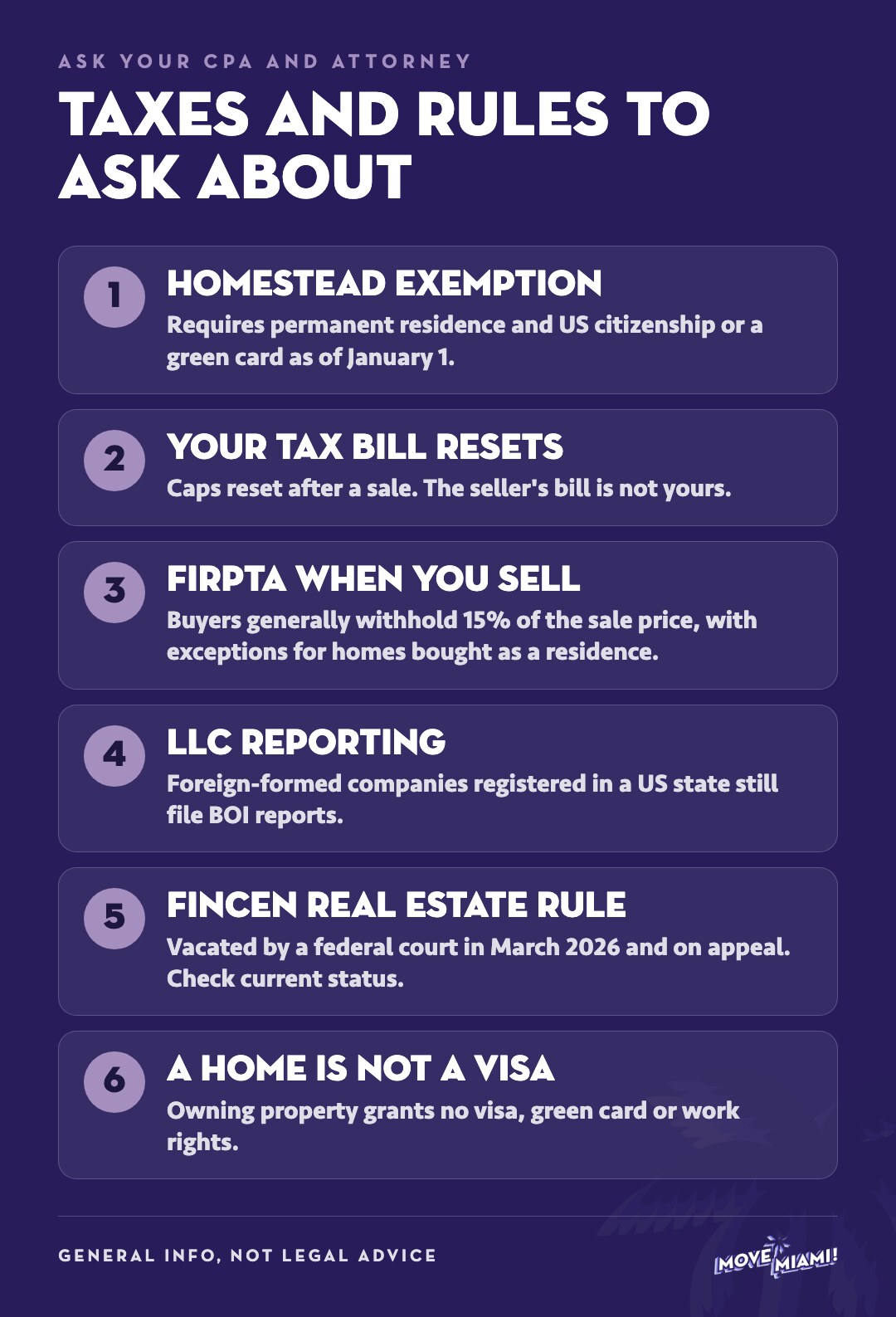
- Homestead exemption: Miami-Dade’s homestead exemption requires that, as of January 1, the home is your permanent residence and you are a US citizen or permanent resident and a Florida resident. Non-resident owners generally do not qualify.
- Your bill resets: Florida’s assessment cap benefits reset after a sale, so do not assume the seller’s tax bill will be yours. Ask for an estimate based on the price you plan to pay.
- FIRPTA when you sell: when a foreign person sells US property, the buyer generally must withhold 15% of the sale price and send it to the IRS. There are exceptions when the buyer will use the home as a residence: no withholding at $300,000 or less, and a 10% rate up to $1 million. A CPA can explain how to file and recover any amount withheld beyond what you owe.
Buying vs Renting from Abroad: How to Choose
Many international clients rent first, learn the neighborhoods, then buy. Others buy right away because they know the city well. This table shows how the two paths compare. On a phone, swipe the table sideways to see both columns.
| Topic | Buying from abroad | Renting from abroad |
|---|---|---|
| What to have ready | Passport, proof of funds or a lender pre-approval, and your attorney and CPA | ID, proof of income, and funds for the deposit and first rent |
| Money up front | Cash, or a down payment and reserves set by your lender, plus closing costs | A security deposit, and sometimes prepaid rent if you have no US credit |
| Approvals | Lender, if financing, and many condo associations | Landlord, and the condo association in many buildings |
| Rules to ask about | Florida’s foreign ownership law, taxes, LLC reporting, flood zone | Lease terms, deposit rules, minimum lease lengths |
| Good fit if | You know the area and plan to stay or hold long term | You are new to Miami or your plans may change |
Our advice: if you have never lived in Miami, a one-year lease is a low-risk way to learn which neighborhood fits your life. If you already know where you want to be, buying lets you lock in the home and the building you like.
Condo Approval and Rental Rules
Many Miami condos screen buyers and tenants before a sale or lease. That power comes from each building’s own documents. Florida law caps the association’s transfer approval fee at $150 per applicant, and, if the documents allow it, the association can require a tenant security deposit of up to one month’s rent.
If you plan to rent the home out, read the building’s current rental rules before you buy. Under Fla. Stat. 718.110(13), an amendment that bans rentals or changes rental terms applies to owners who agree to it and to owners who buy after it takes effect.
Buying from Another Country? Practical Tips
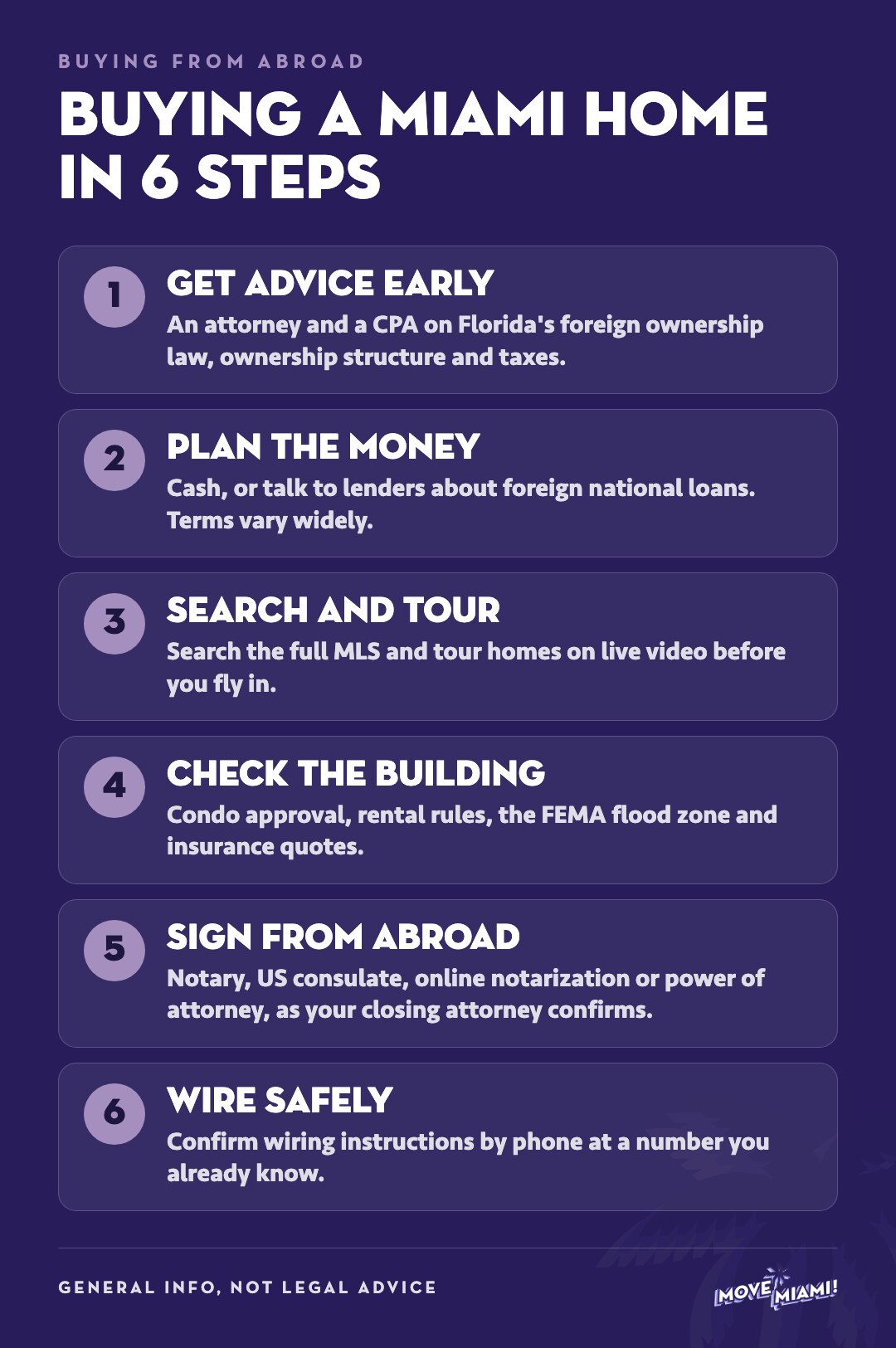
- Close remotely, with your closing attorney’s guidance. Buyers abroad often sign before a notary or at a US consulate, use remote online notarization, or give a trusted person a power of attorney. The closing attorney or title company sets the exact requirements, and Florida has its own power of attorney law.
- Protect your wire. Criminals send fake “updated” wiring instructions by email. NAR advises confirming instructions by phone at a number you already know, distrusting last-minute changes, and calling again after you wire. If something goes wrong, call your bank right away and report it to the FBI at ic3.gov.
- Check the flood zone. Look up any address on FEMA’s Flood Map Service Center. Lenders usually require flood insurance for financed homes in high-risk zones.
- Get insurance quotes early. Homeowners and windstorm insurance can be a real cost in South Florida, so get quotes before you commit. For condos, ask about the building’s master policy and reserves.
Before you tour, use our mortgage and affordability calculators to set a comfortable price range.
Renting a Home in Miami from Abroad
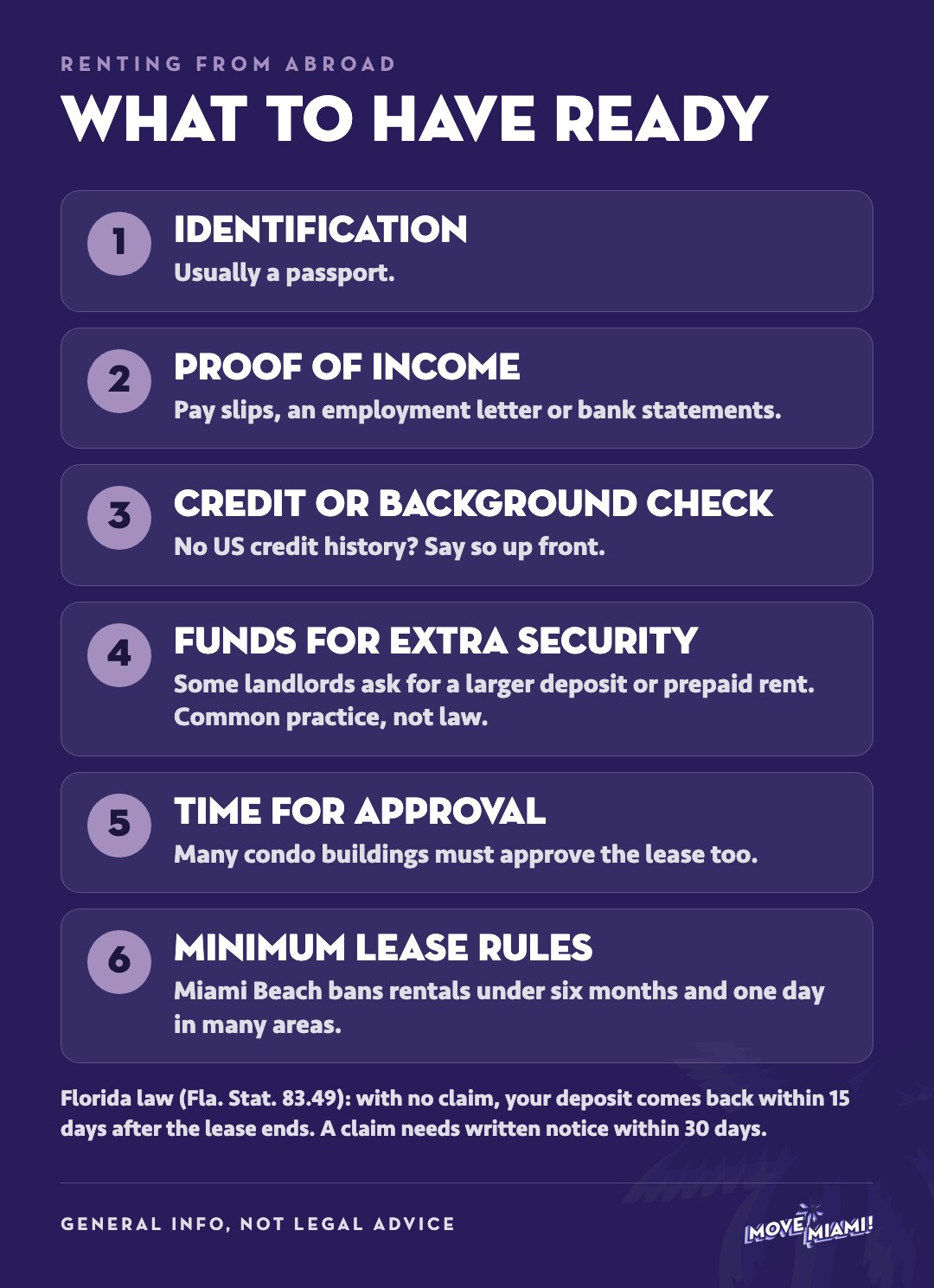
Renting from another country is very doable when your paperwork is ready before you find the place. Good Miami rentals can move quickly, so being prepared helps.
What Landlords Commonly Ask For
- Identification: usually a passport.
- Proof of income: pay slips, an employment letter or bank statements.
- A credit or background check: if you have no US credit history, say so up front.
- Extra security: applicants without US credit are sometimes asked for a larger deposit or several months of prepaid rent. This is common practice, not a legal requirement, and every landlord decides differently.
In a condo, the lease may also need association approval, which adds time. Ask about the building’s process and fees as soon as you apply.
Your Deposit and Florida Law
Florida’s security deposit law, Fla. Stat. 83.49, sets the timelines. If the landlord makes no claim on the deposit, it must be returned within 15 days after the lease ends. If the landlord intends to make a claim, they must send written notice within 30 days, and you then have 15 days to object. Keep a forwarding address on file, especially if you will be outside the US.
Short-Term and Seasonal Rentals
Minimum lease lengths depend on the city and the building. In Miami Beach, the city prohibits rentals of less than six months and one day in single-family homes and multifamily buildings in many areas, and you can check an address with the city’s Practice Safe Renting tool. The City of Miami has its own short-term rental rules, so check with the city for any specific address. Condo rules can be stricter than either city.
Why an Attorney-Led Local Brokerage Makes the Difference

Buying or renting from thousands of miles away can feel like a leap of faith. You cannot drive past the building at night or knock on the neighbor’s door. The answer is a team on the ground that you can trust to be your eyes, and to bring in the right experts.
- A broker who is also an attorney: Victor A. Ruiz, Esq. is a licensed real estate broker and attorney, which shows in how closely we read contracts, condo documents and leases.
- English, Spanish and Portuguese: our team works in all three, so you can ask every question in the language you think in.
- Live video tours: we walk homes on video so you can see the light, the layout and the street before you fly in.
- One coordinated team: we work alongside your lender, title company, attorney and CPA, so deadlines and documents stay on track across time zones.
Getting the Most Out of Your Search from Abroad
- Start with your advisors. A short call with an attorney and a CPA before you shop can change how you buy, and in whose name.
- Search the full MLS. Our home search carries the MLS feed for Miami-Dade and Broward, not just our own listings. Ask us about off-market homes too: we collaborate with agents and owners across the community, and from time to time we have pocket listings that never reach the MLS.
- Send us your short list. We will check building rules, flood zones and rental limits before you book a flight.
- Plan your closing day early. If you will sign from abroad, give the closing attorney time to arrange notary or power of attorney documents.
Frequently Asked Questions About Buying or Renting in Miami from Abroad
Can a foreigner buy a house in Miami?
Generally, yes. There is no general federal ban, and Florida generally allows foreign buyers. Florida’s SB 264 does limit purchases by certain people and entities connected to the countries it names, so ask an attorney whether it applies to you.
Does buying a home in Miami give me a visa or green card?
No. Owning a home does not grant a visa, a green card or the right to work in the US. EB-5 is a separate investment program tied to job-creating businesses, so talk to an immigration attorney about your options.
Can I get a mortgage as a foreign national?
Some lenders offer foreign national loans to buyers without US credit or a Social Security number. They typically ask for a larger down payment and reserves, and terms vary widely. Talk to a licensed lender about your situation.
Do I have to be in Miami to close?
Not always. Here is how buyers abroad usually handle it:
- Ask the closing attorney or title company what they accept.
- Sign before a notary or at a US consulate, or use remote online notarization.
- Or give a trusted person a power of attorney.
- Confirm wiring instructions by phone at a number you already know.
Can I rent out my Miami condo while I live abroad?
It depends on the city and the building. Many condos have their own leasing rules and approvals, and Miami Beach prohibits rentals of less than six months and one day in many areas. Check both before you buy.
Conclusion
A home in Miami is within reach from almost anywhere in the world. The buyers and renters who enjoy the process most are the ones who ask the right questions early, line up good advisors, and let a local team handle the miles in between. Do that, and the day you finally land here feels like coming home.
When you are ready, explore homes for sale across Miami, browse our current Move Miami listings, or message our team on WhatsApp, in English, Spanish or Portuguese. We will help you take the next step at your own pace.

Sources
- National Association of Realtors, Foreign Buyers Purchased $45.3 Billion Worth of US Homes, April 2025 to March 2026
- Florida Statutes, Chapter 692, Part III: Conveyances to Foreign Entities
- U.S. Department of State, Visitor Visa
- USCIS Policy Manual, Volume 6, Part G: Investors
- HUD, Mortgagee Letter 2025-09
- IRS, Individual Taxpayer Identification Number
- FinCEN, Residential Real Estate Reporting and Beneficial Ownership Information
- Miami-Dade Property Appraiser, Homestead Exemption
- Florida Department of Revenue, Save Our Homes Assessment Limitation and Portability
- IRS, FIRPTA Withholding and Exceptions from FIRPTA Withholding
- Florida Statutes, 718.112, Bylaws and 718.110, Amendment of Declaration
- Florida Statutes, Chapter 709, Powers of Attorney
- Florida Statutes, 83.49, Deposit Money or Advance Rent
- City of Miami Beach, Vacation Short Term Rentals and Practice Safe Renting
- National Association of Realtors, Consumer Guide: How to Protect Against Real Estate Wire Fraud
- FBI Internet Crime Complaint Center, ic3.gov
- FEMA, Flood Map Service Center
This article is general information as of October 2026, not legal, tax, immigration or financing advice, and it does not create an attorney-client relationship. Laws, rates and program rules change, and how they apply depends on your nationality, residence and plans. Before you buy, rent, form a company or sign anything, talk to our team and to a licensed attorney, CPA, immigration attorney or lender about your situation. Home search results come from an MLS IDX feed and are deemed reliable but not guaranteed.